Odiham history
The Basingstoke Canal and Greywell Tunnel
The canal is the bit of Odiham history you're most likely to actually spend time with. It runs along the north side of the village, past Colt Hill wharf, through North Warnborough and on to the mouth of Greywell Tunnel, where the water simply disappears into the hill.
Built for farming, never a money-maker
The idea was to give central Hampshire's farmers a cheap way to get timber, flour and chalk to London, with coal and fertiliser coming back. A first route was surveyed in 1769. The one that got built was approved by Act of Parliament in 1778, but work didn't start for another nine years because money was tight during the American War of Independence. William Jessop surveyed it and John Pinkerton built it.
The plan had once looped the canal round Greywell Hill, but the owner of Tylney Hall objected, so they tunnelled straight through instead. According to the Basingstoke Canal Society, the 37-mile canal was finished in 1794 at a cost of £154,463, almost twice the estimate. It never paid. By 1866 the company had gone bust without ever paying a dividend, and a series of later owners included several the Society describes as speculators, three of whom went to prison.
You'll see different opening dates for the canal. The Canal Society and Natural England both say 1794, the Odiham Society says it opened in 1794 with a wharf at Odiham, while Hart's appraisal gives "constructed in 1788 to 92" in one place and "opened in 1798" in another. We'd go with 1794.
The castle and the canal
When the navvies dug past Odiham Castle they cut through the south-west corner of its outer moat and earthworks; Historic England's scheduling notes the damage. The canal crosses the River Whitewater on an aqueduct right next to the ruins.
Walk there (Google Maps)Odiham Castle (King John's Castle)
Colt Hill wharf
The Victoria County History (1911) says the wharf at Colt Hill was once used a lot for shipping chalk from the big pit south of the town, but was disused by then. Today it's where the trip boat and hire boats go from; see our Odiham guide.
Walk there (Google Maps)Colt Hill wharf, Basingstoke Canal
Greywell Tunnel
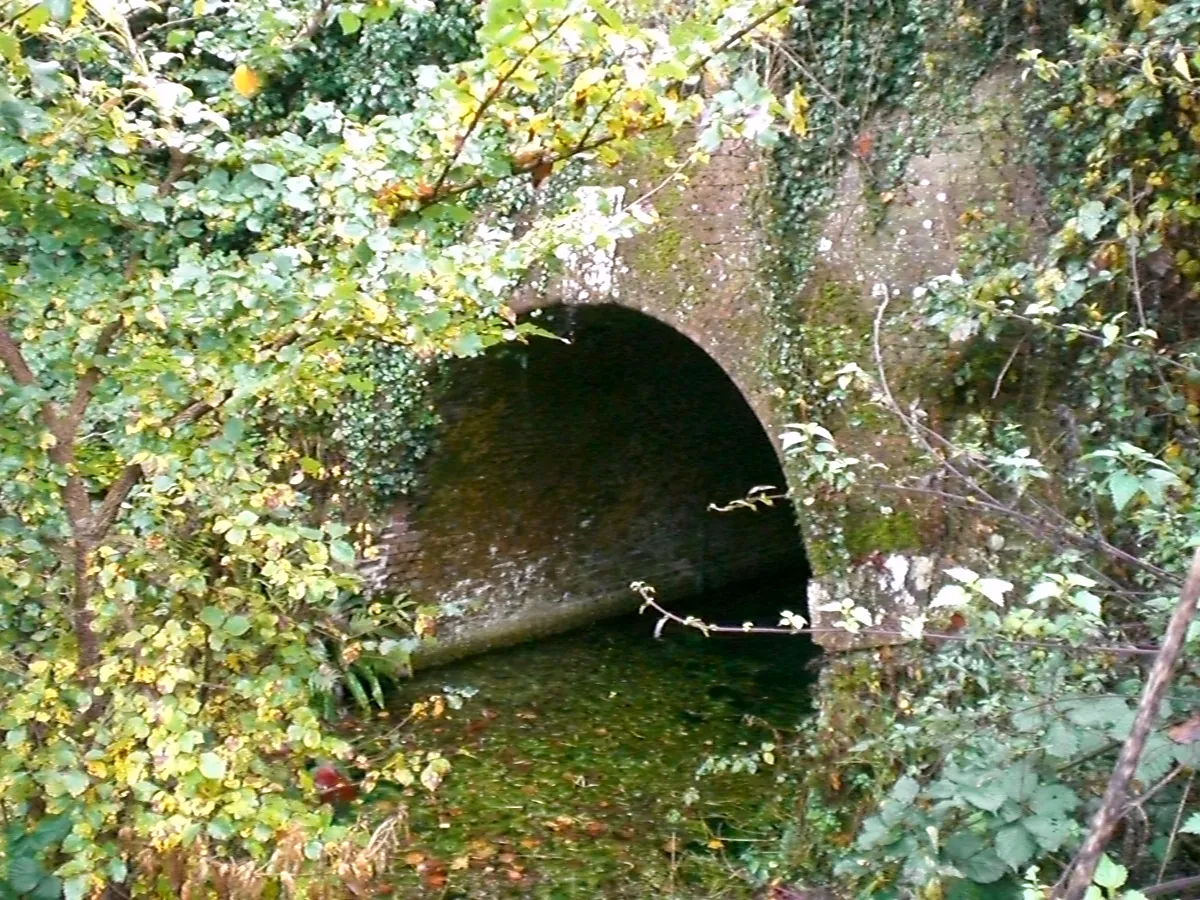
The tunnel is 1,230 yards long (Natural England gives 3,690 feet, which is the same thing). Boats had no towpath through it, so they were "legged" through by men lying on their backs and walking along the roof.
Natural England says commercial traffic used it more or less continuously until February 1914, though there was never much of it. In 1932 a big section of roof collapsed, and that ended any hope of boats getting through to Basingstoke. The western end has also collapsed. About 460 feet of tunnel remain open at the west before the main blockage, then 590 feet filled with soft clay, then 2,640 feet of sound tunnel cut through chalk at the eastern end.
Walk there (Google Maps)Greywell Tunnel (east portal) (no entry, it is a bat roost; see the portal from the towpath)
Bats
The collapse turned out to be a gift for bats. With one end sealed and springs inside keeping the water at about 10°C, the tunnel has a steady climate all year. When Natural England notified it as a Site of Special Scientific Interest in 1985, a single count on 24 January that year found 541 bats, more than anywhere else known in Britain at the time, and they estimated around 2,000 might depend on it. Natterer's bat is the commonest, followed by Daubenton's, with whiskered, Brandt's and brown long-eared bats too. You can't go in, and you shouldn't try.
Restoration
After the Second World War the canal slowly decayed, and by the mid-1960s the locks were rotting and the channel was choked with weed. Then a long restoration campaign began, with Basingstoke Canal Society volunteers doing much of the work. Hart's appraisal says the restoration ran from 1977 to 1991. The western stretch beyond Greywell, including the tunnel, was never restored, partly because of the collapse and partly because of the bats.
Walk it
Our walks from Colt Hill to Odiham Castle and the Mill House, Butter Wood and Greywell Tunnel follow the towpath. There's more in walks around Odiham. Back to the Odiham history hub, or check dates at Laurel Cottage.