Odiham history
North Warnborough
North Warnborough is Odiham's smaller neighbour, about a mile to the north-west, strung out along the River Whitewater. It's in the same parish, and it's where you'll find Odiham Castle, the Mill House and the lift bridge on the canal.
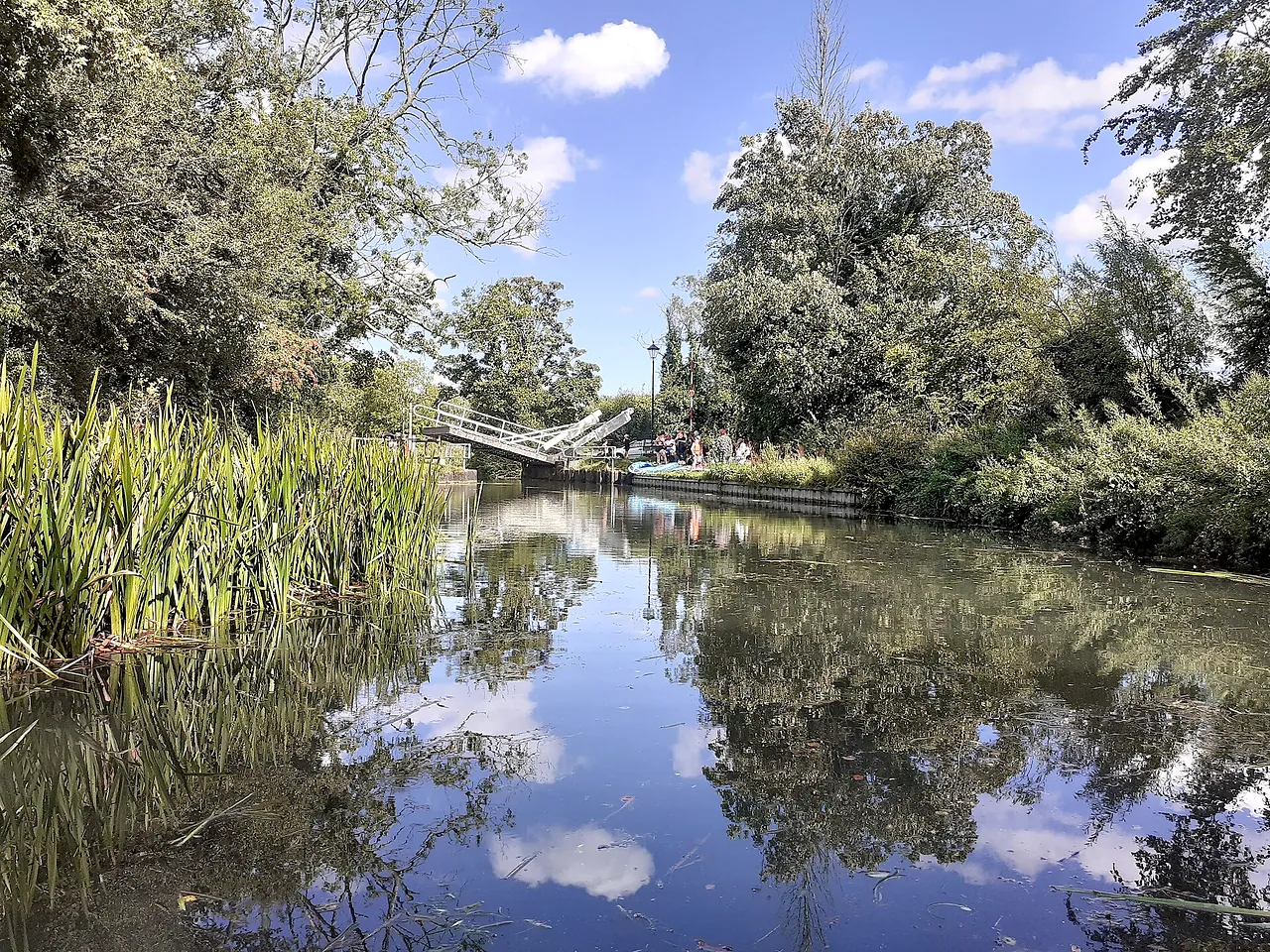
A river village
Odiham village grew along a line of springs, but North Warnborough follows the river. Domesday Book records eight mills in the parish in 1086, and Hart's appraisal thinks two of them were probably on the same sites as the two old mills in North Warnborough today. The Mill House is described as 14th century, on what is probably a much older mill site, and Castle Mill near the castle is now a house. A fulling mill (for finishing woollen cloth) is recorded at North Warnborough in 1555 to 1556.
Medieval cottages
North Warnborough has a remarkable number of late medieval timber-framed houses, several of them former hall houses with a big open hall and a fire in the middle of the floor. Hart's appraisal picks out:
- Cruck Cottage, tree-ring dated to 1383 to 1384, and one of the most easterly examples of cruck construction (big curved timbers running from ground to ridge) in the country.
- The Thatched Cottage, dated 1445 to 1446.
- Tudor Cottage (14th century), Springwell House and Strete Farm.
- Castlebridge Cottages, a Grade II listed terrace of twelve cottages from the 15th and 16th centuries.
These are all private homes, so please enjoy them from the road.
The Civil War skirmish of 1644
In the 1640s North Warnborough sat between the Royalist garrison at Basing House and the Parliamentarians at Farnham. In early June 1644 a Royalist raiding party from Basing was caught near "Walneborough Mill, within halfe a mile of Odium" by Parliamentarian horse under Colonel Norton and foot under Colonel Jones.
A pamphlet printed straight afterwards in London, headed "A great victory obtained by Colonel Norton...", lists the prisoners: a sergeant major, a captain, two lieutenants, two ensigns, the Marquis of Winchester's surgeon, three gentlemen at arms, three sergeants, three drummers with five drums, 75 common soldiers and 100 weapons, with four Royalists killed. It also gleefully notes that one officer had been a mercer in Paternoster Row and another a scrivener at Holborn Bridge. Hart's appraisal puts it as a battle at Warnborough Green where 150 Royalists were taken prisoner and many killed, which is a bigger number than the pamphlet gives. Bear in mind that a victory pamphlet isn't neutral either.
Warnborough Green
Warnborough Green, in the middle of the village, is now a Site of Special Scientific Interest for its wet grassland.
Walk there (Google Maps)Warnborough Green, North Warnborough
Lodge Farm
Just north-east of the castle is Lodge Farm, where a Roman house with baths was dug up in 1929 to 1930 (see early Odiham). Hampshire Gardens Trust says Lodge Farm also stands on the site of the medieval royal park lodge, rebuilt in 1368 to 1369.
Walk it
Our Odiham, North Warnborough and King John's Castle walk goes through the village, and the Mill House, Butter Wood and Greywell Tunnel walk starts nearby. The Mill House and the Anchor are both in our Odiham guide. Back to the Odiham history hub, or check dates at Laurel Cottage.
Walk there (Google Maps)Odiham Castle (King John's Castle)
Sources
- Hart DC, Odiham and North Warnborough Conservation Area Appraisal (2022)
- Victoria County History, Hampshire vol. 4, Odiham (mills, North Warnborough manor)
- "A great victory obtained by Colonel Norton and his horse..." (1644), Oxford Text Archive
- BCW Project, Second Newbury campaign (context for the June 1644 action)
- Hampshire Gardens Trust, Odiham Deer Park